
Rising From F to As through Circus Arts

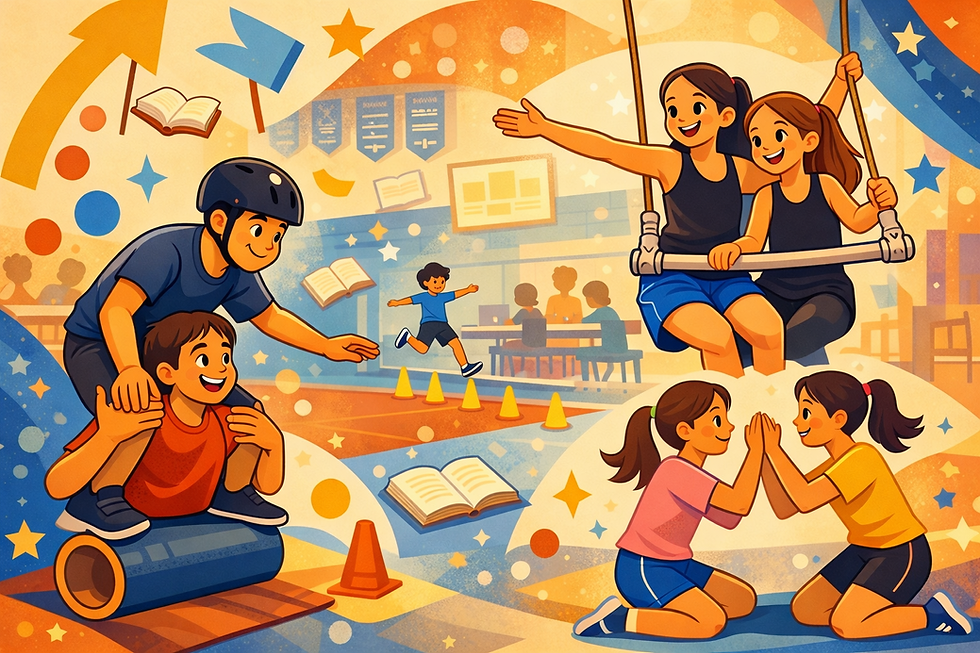
How a shared performance can help young people develop confidence, resilience, teamwork, and the skills to take on new challenges.
Before joining Circus of the Kids, Sam was struggling at school. He had scored 17 on a math test, regularly arrived late to class, and received zeros on his reading assessments. He wanted to participate in the circus, but his mother was hesitant.
According to Bruce Pfeffer, what followed over the next two weeks changed how Sam approached both school and himself. With tutoring, daily reading, and clear expectations tied to attending rehearsals, Sam scored 92 when he retook the math test. His reading assessment scores reached 80 percent or higher. During the second week, he arrived on time for all 35 of his classes.
Sam’s story was one of the examples Bruce shared during PM4TheWorld’s September 16, 2026 webinar, “Rising From F to A’s: Youth Development, Confidence, and Life Skills in Action through Circus Arts.” As founder and president of Circus of the Kids, Bruce has spent more than four decades working with young people in schools and camps. His central message was that a carefully supported challenge can give children evidence of abilities they had never recognized in themselves.
As he put it: “The applause is the reward. The preparation is the transformation.”
That preparation begins with giving every child a place. Bruce described a typical school residency lasting about two weeks, starting with opportunities to explore circus skills before casting an after-school production. Placement auditions help coaches identify a suitable role for each participant. Every child gets into the show, and scholarships help remove financial barriers.
The question guiding the coaches is simple: “How can we make this child successful?”
That question matters educationally. A child who struggles in a classroom or feels overlooked in a competitive activity can discover a different way to contribute. Learning to juggle, taking part in an aerial act, or helping a group coordinate a routine makes progress tangible. Practice produces something the child can see and experience. Teachers, classmates, and parents may also begin to recognize capabilities they had not previously seen.
Bruce described four conditions behind these experiences: meaningful risk, belonging, structure, and visible achievement. The challenge must stretch the child while remaining achievable with support. Their role must make them feel needed. Instructions and coaching must make the next step clear. Finally, they need an opportunity to recognize what they have accomplished.
A performance date gives those conditions urgency. Families are coming, fellow performers are depending on one another, and today’s rehearsal has a purpose. Bruce also emphasized the responsibility that comes with creating that pressure: children need patient coaching, appropriate protection, and help when they struggle.
Self-confidence develops through this relationship between effort and accomplishment. Bruce recognized it in his own childhood. A boy who believed he had poor coordination learned to juggle and gradually discovered that he could master demanding physical skills. In the experiences he described, confidence grew as children accumulated evidence that they could do something difficult.
“Action comes first, and then confidence follows,” he explained.
Teamwork becomes equally concrete. During the discussion, circus coach Sarah described working with three girls from different school grades who had not previously known one another. Sharing an aerial apparatus required them to coordinate their movements, consider one another’s positions, and learn how to work within the same space. Over successive rehearsals, she saw their confidence and cooperation grow.
Their shared task gave them a reason to listen, adjust, and trust each other. Each participant’s contribution affected what the group could accomplish.
These experiences also offer opportunities to practice leadership. Arriving prepared, accepting responsibility, supporting a nervous teammate, and responding constructively to feedback are everyday leadership behaviors. A child can contribute to the group’s success through reliability and care for others, regardless of whether they hold a formal leadership role.
Resilience develops through the work of learning, too. An unfamiliar skill can be frustrating or intimidating. Rehearsal creates opportunities to attempt it, receive guidance, make adjustments, and try again. With support, children can experience difficulty as something they can work through. That experience gives them a reference point when they encounter another demanding task.
For the PM4TheWorld community, the connection with project management is readily visible. A circus production has a shared objective, defined roles, limited rehearsal time, interdependent activities, and a fixed delivery date. Coaches coordinate people and resources while adapting to participants’ needs and existing commitments. The production brings together children, families, the host organization, and an audience.
Bruce explained that arranging a residency can begin about a year in advance, with schools and camps helping recruit participants before the circus team arrives. During the residency, children experience the practical importance of preparation, commitments, and coordination. They see how their individual work contributes to a result that nobody could produce alone.
There is a lesson here for project leaders: the way a project is organized can help people develop competence as they deliver it. Clear expectations, accessible support, and meaningful responsibility influence both the result and the participants’ experience.
Program management adds a longer perspective. Each residency is a bounded undertaking, while the wider purpose concerns young people’s development across schools, communities, and time. From that perspective, the performance is one milestone. The benefits worth understanding include whether participants remain more willing to attempt difficult work, cooperate with others, engage in school, and take responsibility.
The webinar’s closing discussion addressed that question directly. Audience members asked what happens after the circus leaves and how teachers build on the experience. Former participant Christy described the confidence and trust she developed through circus and later chose to give her own children a similar opportunity. Bruce also shared accounts of former participants who contacted him years later to describe the experience’s importance in their lives.
These individual accounts offer valuable insight. Establishing how consistently benefits endure would require more systematic follow-up, a point reflected in host Olivier Lazar’s observations about measuring lasting social impact. For organizations delivering youth development programs, this suggests involving teachers and families in identifying what changes, reinforcing progress, and understanding what remains months after an activity ends.
The educational value explored in this webinar lies in the opportunity to practice capabilities that matter throughout life. Children work toward a goal, learn alongside others, manage frustration, and discover that their contribution matters.
For those of us working in project and program management, Bruce’s examples invite a useful question when designing an initiative: what will participants become more capable of doing through the experience of delivering it?
A successful performance gives a community something to celebrate. The preparation can give a young person a new reason to believe in what they can attempt next. You can watch the recording of the webinar here.


Comments